Anatomical discovery · reviewed
Venous valves
Influential account published 1603Valves in many veins guide blood toward the heart and limit backward flow.
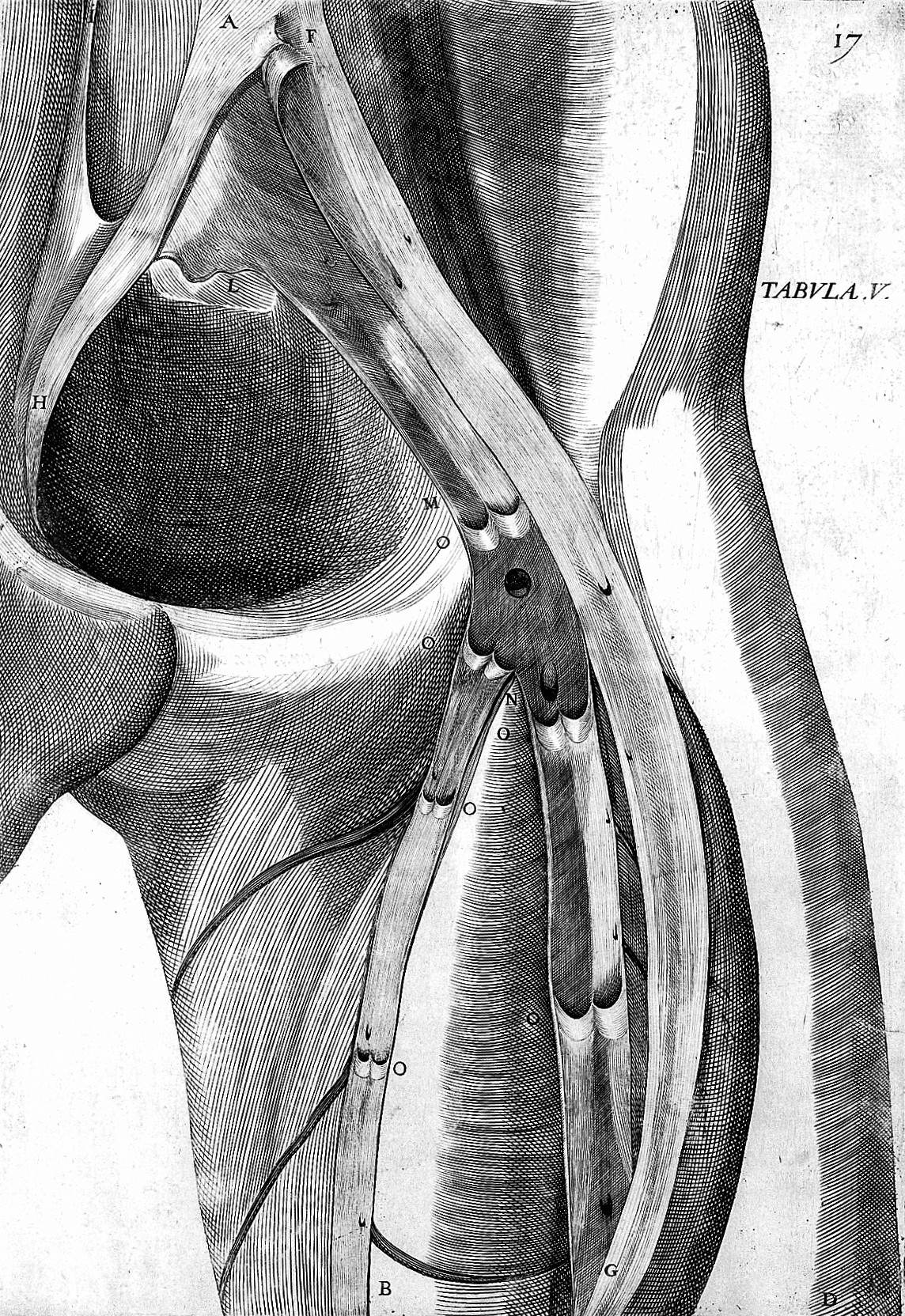
Fabricius's 1603 De venarum ostiolis supplied a detailed, illustrated study of venous valves. The structures had been observed earlier, and Fabricius interpreted them differently from Harvey's later circulation model. These thin folds allow blood to pass in one direction and resist backward flow. Fabricius described their structure but did not infer modern circulation; Harvey later used their orientation, together with experiments and quantitative reasoning, as evidence for blood returning toward the heart.
Sources
- Hieronymus Fabricius Ab Aquapendente (1537–1619) and the discovery of venous valves — A. K. D. D. De Silva et al., 2023
- Who discovered the valves in the veins? — Paolo M. F. M. van der Waal et al., 2021
Direct relationships
- Hieronymus Fabricius→Venous valvesPublished an influential illustrated account of venous valves · high confidence
- Venous valves→Circulation of bloodTheir orientation supplied evidence for one-way venous return · high confidence